

Fences and decks
Fire-resistant fences and decks. Where fire walks up to the house.
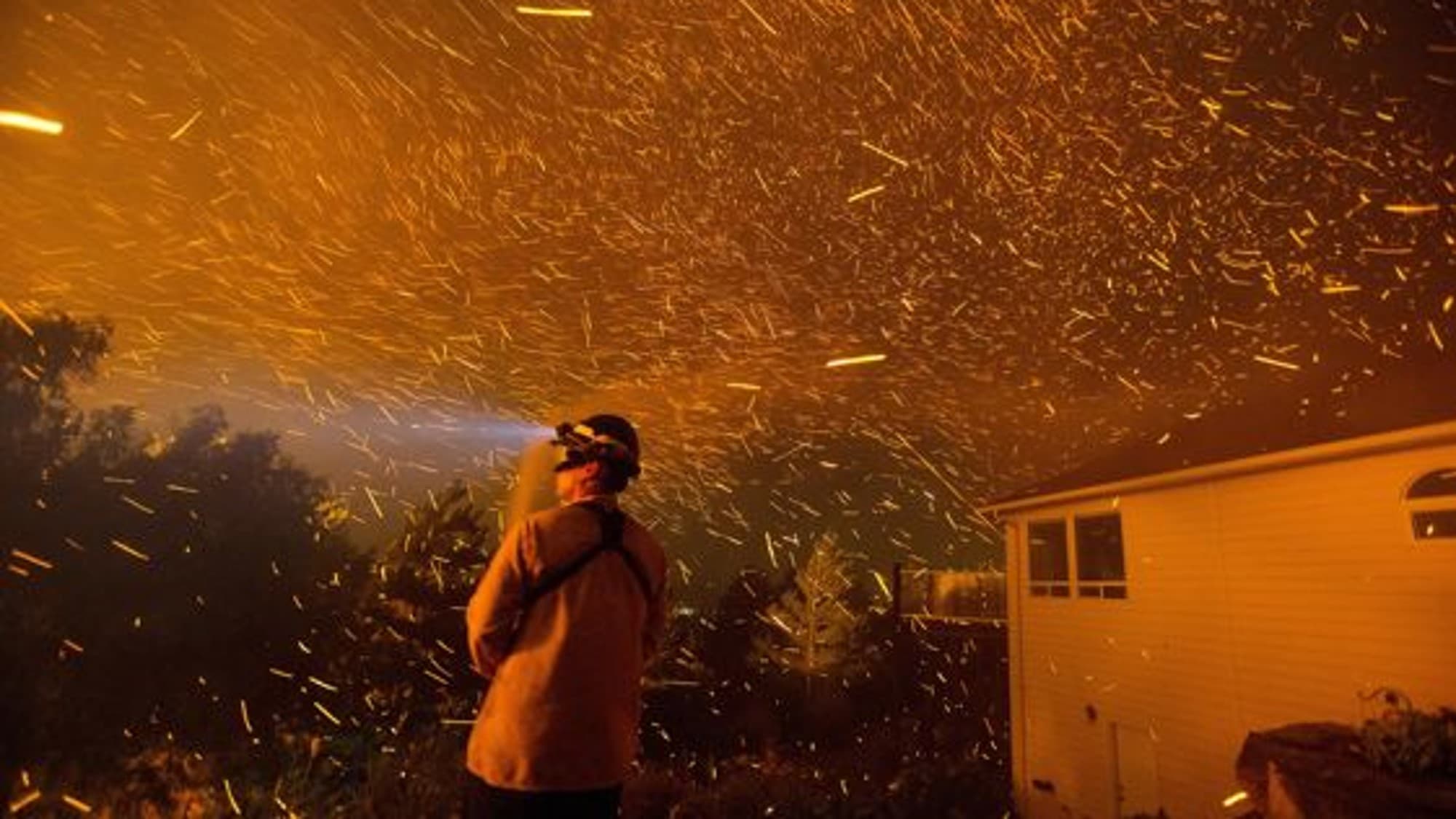
In the 2025 LA fires, fences were the most common path fire took to the house. Decks did the same thing from below. Here's what the evidence says, what LA rules require, and the first fix most homes can make.
Updated November 10, 2026
Nearly 70%
of Palisades Fire cases IBHS studied had a fence give fire a direct path to the house. In the Eaton Fire it was 57 percent.
Over 95%
of LA parcels IBHS surveyed had a fence, and 61 percent were attached to the house or inside the first 5 feet.
63%
of surveyed homes had a deck, mostly with wood walking surfaces.
The short answer
Break the connection to the house.
A wood or vinyl fence that runs into your wall works like a fuse. IBHS saw it again and again in the 2025 fires, and also saw what stopped it: "A vinyl fence burned up to a gate. The gate, which featured a metal frame, likely interrupted fire spread."
- 01
Put metal where the fence meets the house
Swap the last section and gate for metal or masonry. IBHS's standard asks for noncombustible fencing within 5 feet; the Headwaters study says ideally 10 feet out from the home.
- 02
Keep plants and mulch off fence lines
NIST found mulch at the base is what lets fire run along a fence, and IBHS found plants along metal and masonry fences cancelled their benefit.
- 03
Clear and close in under the deck
Remove everything stored and growing underneath, add metal flashing where the deck meets the wall, and screen the underside of low decks with 1/8-inch metal mesh.
- 04
Upgrade decking when it's due
Use a tested ignition-resistant or noncombustible surface, and consider a metal grate for the first board along the house.
Fences: the evidence
Combustible fences are fast conduits.
- LA 2025 fires (IBHS)
- Fences were "a direct pathway for fire spread in nearly 70% of Palisades Fire cases and 57% of Eaton Fire cases." Most fences were wood. Masonry walls, by contrast, "can effectively minimize radiation and intermittent flame contact from burning neighbors."
- NIST fence experiments
- In 187 experiments, NIST found "combustible fences can be rapid conduits for fire," and fences with mulch at the base were high hazard. In an earlier study, "a mulch bed was required for flames to spread" along the fence. NIST also measured embers igniting fuels more than 155 feet downwind.
- Vinyl fences
- In NIST tests, vinyl privacy fences didn't burn much on their own, but with mulch at the base the boards warped and fell out. IBHS and Fire Safe Marin still count vinyl as combustible.
- Metal isn't set and forget
- "Noncombustible fences free of leaf litter and other combustible debris will not spread fire," says NIST. In LA, IBHS found vines and plants along metal and masonry fences carried fire anyway.
Fences: the rules
No state fence mandate. Insurers still care.
- California building code
- The 2025 wildfire code has no mandatory fence rule. Removing combustible fences within 5 feet appears only in its voluntary Appendix G.
- Insurance discount
- California's Safer from Wildfires rules count "only noncombustible materials" within 5 feet of the house, "including fences and gates," as a discount factor.
- IBHS Wildfire Prepared Home
- Requires removing or replacing combustible fencing, posts, gates and retaining walls within 5 feet. Its Plus level also bans back-to-back combustible fences closer than 5 feet apart.
- Zone 0 (not in force)
- The Board of Forestry's August 2026 draft would have barred combustible fences and gates from attaching to the house and required a 5-foot noncombustible span. Those rules were withdrawn from legal review on September 8, 2026, and nothing has been refiled. Latest Zone 0 status.
Decks: the evidence
Decks burn from the gaps and from below.
IBHS's deck research found "ignition typically occurred from ember accumulation in gaps between deck boards at joist crossings," and redwood tops were particularly vulnerable. No-gap metal boards or a concrete surface stalled flames spreading underneath. In ember tests, softwood decking flamed after about 12 minutes and one composite after about 48 minutes, while fire-retardant-treated wood and other composites only smoldered.
The Headwaters study notes that nearly all common decking burns except metal, concrete and flagstone, and that fires under a deck grow faster than fires on top. A study of California losses from 2013 to 2018 found composite decking carried significantly lower risk than other materials, but some composites still fail, so check the product's listing.
In LA, IBHS found decks, hot tubs and pergolas acted as connecting fuel, and roof-attached decks in the Palisades became "a receptive fuel bed for ember accumulation."
Decks: the rules
What a deck needs under the code.
- Flashing at the wall
- California's 2025 wildfire code requires "a minimum of a 6-inch metal flashing" at every deck-to-wall intersection on new decks (504.7.3.1).
- Walking surface
- New decks in fire zones need a tested ignition-resistant, fire-retardant-treated or noncombustible surface. The code's deck tests don't include embers, IBHS notes.
- City of Los Angeles
- If a deck is within 10 feet of the house, its walking surface must be protected, and in Very High zones the area under unroofed decks must be completely enclosed (LADBS bulletin P/BC 2026-023).
- Under the deck
- Clearing vegetation and debris from under decks is an insurance discount factor under Safer from Wildfires. IBHS's standard requires bare soil underneath, nothing stored, 6 inches of noncombustible material at post bases, and 1/8-inch metal mesh enclosing decks 4 feet or less off the ground.
Costs
What fence and deck fixes cost.
| Item | Typical installed cost |
|---|---|
| Fiber cement fence panels on steel posts, 5 to 10 ft from the house, 8 ft tall, both sides | About $9,700 including removal. Metal or chain link can cost less; a chain link gate is about $150. |
| Metal flashing at the deck-to-wall joint | About $2.70 per linear foot |
| Metal grate replacing the first deck board along the house | About $104 per linear foot, about $1,000 per 10 feet |
| Metal mesh skirting under the deck | About $27 per sq ft |
| Composite decking | About $7.90 per linear foot. A 10x10 deck with composite boards, joist tape and flashing: $2,500 to $3,000. |
| Concrete deck surface | About $11 per sq ft, not counting removal |
| Steel deck on a steel structure | About $67 per sq ft, over $9,000 for 100 sq ft |
Source: Headwaters Economics and Quarles (2024), Northern California prices. A 2025 Headwaters and IBHS study for Altadena priced metal fencing for the 5-foot zone at about $760 in materials.
How RF1 helps
Fence connections are an RF1 service.
Mark maps every fence, gate and deck that touches the house during the assessment. RF1 coordinates the noncombustible fence sections and gates where they meet the house, the under-deck clearing and mesh, and deck-to-wall flashing, then documents it for your insurer. For full deck rebuilds, we help you plan the materials and scope with a qualified builder.
Questions
Fence and deck questions we hear most.
- Do I have to replace my wood fence?
- Not under current state law. The building code's fence guidance is voluntary and California's Zone 0 rules aren't in force. IBHS certification and the Safer from Wildfires insurance discount do require noncombustible materials within 5 feet. The best-supported first step is a metal gate or noncombustible section where the fence meets the house.
- Is a vinyl fence fire resistant?
- No. Vinyl is combustible. In NIST tests it didn't burn much on its own, but with mulch at its base the boards warped and fell out.
- What's the best fence material for fire?
- Masonry, stone or metal, kept free of vines, plants and leaf litter. IBHS found plants growing along noncombustible fences in the 2025 LA fires cancelled their benefit.
- Is composite decking fire resistant?
- Some composites performed much better than wood in testing and in California loss data, but some still burn. Check that the specific product is listed for use in fire zones.
- What should I do under my deck?
- Clear it to bare soil, store nothing there, add 6 inches of noncombustible material at post bases, and enclose low decks with 1/8-inch metal mesh. Clearing under decks also counts toward the Safer from Wildfires insurance discount.
- Does a code-compliant deck stop embers?
- Not necessarily. The code's deck tests don't include embers, and IBHS found embers collecting in the gaps between boards were the main way decks ignited.
- Is a hot tub near the house a problem?
- It can be. IBHS documented windows failing next to a burning hot tub and deck in the LA fires, and its standard keeps hot tubs at least 10 feet from walls.
Keep going
Sources
- IBHS, The 2025 LA Conflagrations, executive summary (December 2025)
- IBHS, The 2025 LA Conflagrations, full report
- IBHS, early field observations from the Palisades and Eaton fires (March 2025)
- NIST Technical Note 2228, fire spread along fences
- NIST Technical Note 1894, wind and fire spread along privacy fences
- IBHS, vulnerability of decks to embers and flames
- IBHS deck testing executive summary (2018)
- 2025 California Wildland-Urban Interface Code, Chapter 5 (gocodebook mirror)
- LADBS P/BC 2026-023, decks and fire-retardant roof coverings
- State Fire Marshal 08/24 rulemaking (WUI Code Appendix G)
- IBHS Wildfire Prepared Home 2025 Technical Standard
- 10 CCR 2644.9, California Department of Insurance wildfire mitigation discount factors
- Board of Forestry Zone 0 draft summary, August 2026 (UC ANR copy; not in force)
- Syphard and Keeley (2019), factors in California structure losses, 2013 to 2018
- Headwaters Economics and Quarles, Retrofitting a Home for Wildfire Resistance (2024, CAL FIRE funded)
- Headwaters Economics and IBHS, construction costs for wildfire-resistant homes (2025)
- Fire Safe Marin, fences
Facts checked November 10, 2026. Costs are rounded from the 2024 Headwaters Economics study for CAL FIRE (Northern California prices; Southern California tends to land within 10 percent). They're a benchmark, not RF1 quotes.
Don't wait for the next red flag day. Start with one call.
A free assessment, a plan with prices, and one team to do the work. Pasadena, Altadena and across Southern California.